I was eight years old when my sister Carol died.
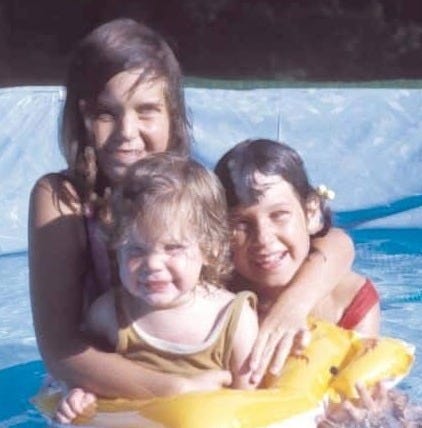
Carol was ten years older than me. She was my entertainer, my caretaker, my cheerleader, my coach. She went away to college as a freshman and never came back.
I remember the stomach aches more than I remember the funeral.
Actually, that’s not quite true. I remember one moment from the funeral with perfect clarity.
The church was packed. My sister lay there in a casket—though I tried not to look at it, tried not to think about what that meant. I was in the front pew, sitting up straight, trying to be perfect. Trying to do this right, whatever “right” meant.
At the end of the service, our family followed the casket out of the church. I felt a lump in my throat rising. I didn’t see any of the people in attendance—there must have been hundreds, but they blurred into nothing. All I could see was the door at the back of the church. I knew I had to get out.
Twenty feet to go. Then ten.
And then, with absolutely no control, a single wail came out of me that I didn’t know my 55-pound body could hold.
It came from somewhere deep, somewhere I didn’t know existed. It wasn’t crying—it was something more primal. My body had forsaken me. Or maybe it had finally told the truth I’d been trying to hide.
After that, it went underground. I went back to being the good kid who had it together. And the grief came out sideways—in stomach aches that sent me to the nurse’s office on repeat. I remember that office: the food pyramid poster, the crinkle of paper on the little cot, the clock that seemed to move slower than any other clock in the building. I spent a lot of time there that year.
What I don’t remember is anyone teaching me how to grieve.
The Silence Wasn’t at School—It Was at Home
Life went on. Kids at school were fine. They didn’t avoid me. Looking back, I’m not sure most of them even knew.
The silence wasn’t at school. It was at home.
My family kept a stiff upper lip. My parents, my siblings—everyone just carried on. We didn’t talk about what happened. We didn’t cry together.
We just kept going.
And because nobody in my family was openly grieving, I didn’t know that grieving openly was an option. I didn’t know you were allowed to fall apart. I didn’t know you were supposed to talk about it, cry about it, rage about it.
I thought the way you handled death was: you keep going. You stay strong. You don’t make it harder for everyone else.
Nobody told me I needed to be strong—nobody said those words. But I knew, even at eight years old, that no parent should ever have to outlive their child. I could see how much pain everyone was in. And somewhere in my eight-year-old brain, I decided that falling apart with them would be unfair. They’d already lost Carol. I couldn’t be one more thing breaking.
So I swallowed everything. The sadness, the confusion, the anger, the fear—all of it went down deep where nobody could see it.
And because I didn’t have the language to articulate anything about grief—because I didn’t even know that what I was feeling was grief—it came out the only way it could: in my body.
Stomach aches that could be addressed with a teacher’s note and a trip to the nurse’s office, but couldn’t be fixed.
The Family Across the Street
I thought I was fine. I really did.
On the outside, I probably looked like a normal eight-year-old kid. But inside, I was drowning.
Carol’s death was completely unexpected. One day she was here, and then she wasn’t. There was no time to prepare, no chance to say goodbye. Just sudden, absolute absence.
And then there was the family across the street.
They never made a big deal out of anything. They never sat me down for a serious talk about death or feelings. They never asked probing questions or gave me that tilted-head sympathy face.
They just quietly invited me over. And then invited me again. And again.
I spent weeks at their house that year. My best friend Susan had a bright pink room with a white wicker bed—I can still see it perfectly. Her mom Pat would come home from work and make meatloaf or pierogies. She’d put olives in the salad that I loved—and sometimes even Doritos.
These details probably seem small. But they mattered. They were normal. They were a world where the most important thing happening was whether dinner would be meatloaf or pierogies.
At the time, I assumed I was there to give my parents one less thing to worry about. Looking back now, I realize what they were really doing: giving me a safe place to just be. My house was serious and sad. Susan’s house was wonderfully normal. A place where I could eat dinner with a family that laughed and bickered about regular things. A place where grief wasn’t the center of everything.
Pat never tried to fix me. She just opened her home and let me exist in it.
I will always be grateful for that. Those quiet invitations—repeated week after week, those dinners around their table, that bright pink room—were exactly what I needed.
The Priest Who Didn’t Understand
Not everyone got it.
The priest came to talk to me. I’m sure he was a nice man. He meant well. But I just wasn’t having it.
My parents made me meet with him alone, which already felt wrong. I was eight, suddenly in a room by myself with this man in a collar who kept looking at me with that tilted-head sympathy face.
He asked me if I understood what death was. If I understood that it was final. That my sister wasn’t coming back.
I was indignant. Of course I understood. Did he think I was stupid? I knew what death meant. I knew she was gone.
What I didn’t know—what nobody was helping me with—was what to do with that knowledge. How to exist in a world where she was gone. How to carry a weight I couldn’t name.
But he didn’t ask about that. He just wanted to make sure I intellectually understood the permanence of death, as if that was the problem. His sympathy felt like he was checking a box: Talk to the kid. Make sure she gets it. Mission accomplished.
It made me feel smaller. Less understood. More alone.
After that meeting, the stomach aches got worse.
What I Wish I Had Known
I’m a lot older than eight now, and I’ve learned some things about grief that I wish I had understood back then.
Grief doesn’t need words to be real. Just because I couldn’t articulate what I was feeling doesn’t mean it wasn’t valid. Just because I looked “fine” doesn’t mean I was fine.
Your body tells the truth when your mouth can’t. That wail at the funeral—the one I had no control over—that was my body speaking. When I shut that down and went back to being the “good kid,” my body found other ways: stomach aches, exhaustion, a constant knot in my chest. Grief lives in your body, not just your mind. You can channel it or suppress it, but you can’t make it disappear.
Silence about grief isn’t strength—it’s just silence. My family wasn’t trying to be unfeeling. My dad was a stoic WWII vet and my mom was a no-nonsense housewife and mother of five. They were doing the best they could with what they knew. But they accidentally taught me that grief was something to hide, not something to feel. Falling apart is allowed. Crying isn’t weakness. Talking about it isn’t making it worse.
Sometimes the best help doesn’t look like help at all. Pat didn’t try to talk to me about my feelings. She just gave me a place to be normal for a while. Sometimes that’s exactly what someone needs—not therapy or advice, but permission to exist without the weight of loss being the only thing in the room.
There’s no timeline for “getting over it.” There’s just learning to carry it. And that takes as long as it takes.
Why I’m Building Ripple
I’m telling you this story because it’s the reason Ripple exists.
When Carol died, I needed something I couldn’t find: a place where grief wasn’t awkward or something to be gotten over. A place where I could say “I’m struggling” without someone immediately trying to fix me.
I needed community. I needed people who’d been through it. I needed to know I wasn’t alone.
And I needed practical help—because grief isn’t just emotional, it’s logistical. There are decisions to make, paperwork to file, things to figure out at the exact moment when your brain can barely function.
So I’m building Ripple to be all of that. A place where you can talk about grief honestly, without the platitudes. A community of people who actually understand. Practical tools for navigating the impossible logistics of loss.
We’re building the thing I wish had existed when I was eight years old, lying in the nurse’s office, trying to figure out why everything hurt and why no one seemed to know how to help.
What Now?
If you’re reading this and you’ve lost someone, I’m sorry. Not the performative kind of sorry. The I know this changes everything and there’s nothing anyone can say that will make it better kind of sorry.
If you love someone who’s grieving and you have no idea what to say—I get it. Here’s what I know:
You don’t need the right words. Just show up. Invite them to dinner. Send a text three months later that says “thinking of you.” Let them be normal for an hour. Don’t disappear at month six when the numbness wears off and the grief really hits.
And if you’re the one grieving: those stomach aches, those sleepless nights, that exhaustion—that’s your body trying to process what your mind can’t. Listen to it. Be gentle with it.
You don’t have to be strong. You just have to survive today. And then the next one.
I still think about Carol. I still get sad sometimes, decades later. And I still think about Pat and Susan. About that bright pink room with the white wicker bed. About pierogies and meatloaf and olives—and sometimes Doritos—in the salad. About those quiet invitations that kept coming, week after week, without explanation.
Pat never made me talk about my grief. She just gave me a place to be a kid for a while.
That’s what people need when they’re grieving. Not someone with all the answers. Just someone who shows up. Someone who makes meatloaf and puts olives in the salad and acts like everything is normal, even when nothing is.
Grief shouldn’t be something we figure out alone.
— Mary Matyas
P.S. If this resonated with you, share it. Not because I’m trying to build an audience (though I am), but because someone you know is probably in their own version of that nurse’s office right now, feeling alone and wondering if anyone understands. Let them know they’re not alone. That’s what Pat did for me.
Comments are open. What do you wish someone had told you about grief?